
What Time and Materials Looks Like
T&M is the traditional model. You charge for the time you spend and the parts you use. A tech who takes 2 hours at $120/hour plus $200 in parts bills $440. One who takes 3 hours bills $560.
The appeal of T&M is simplicity: you can't lose money on a job that takes longer than expected.
The problem is that it creates misalignment everywhere:
- Slower techs make more money on the same job
- Customers worry the tech is dragging their feet
- You can't quote a price upfront, which creates friction and distrust
- Customers feel like they're being charged by the hour for you to figure out their problem
What Flat Rate Looks Like
Flat rate pricing charges by the job, not the time. A condenser fan motor replacement is $X, regardless of whether it takes 45 minutes or 90. The customer knows the price before work starts.
The appeal is enormous from a customer experience standpoint. People hate uncertainty. Knowing the price upfront reduces anxiety and makes them more willing to approve the work. It also positions your techs as professionals, not hourly workers.
Flat rate also rewards efficiency. A tech who has done 300 condenser fan motor replacements and can do it in 45 minutes makes the company more money than one who takes 90. That's the right incentive structure.
The Case for Flat Rate
Here's the bottom line: flat rate companies almost universally have higher average tickets, higher close rates, and better customer reviews. That's not an accident.
When a tech shows a flat rate price, the customer makes one decision: yes or no. When a tech works T&M, the customer spends the whole time watching the clock and calculating what the bill might be. That anxiety produces friction, complaints, and refusals.
Flat rate also enables upselling. When the repair price is clear, techs can present options: "Here's the repair at $280. Here's a new unit that eliminates this class of problem at $X. Want me to walk you through both?" That's a professional conversation. T&M makes that conversation much harder.
The Transition
Moving from T&M to flat rate isn't painless. Your techs need training on using a price book, presenting prices confidently, and handling "why does a capacitor cost $180?" conversations.
The answer to that last one is honest: "Our price includes the part, the diagnostic, the labor, and our warranty on the work. If there's any issue after this repair, we come back at no charge." That's a complete answer most customers accept.
The bigger challenge is building your price book accurately. Prices need to cover your fully-loaded labor cost, parts cost, overhead, and margin. If you price flat rate based on T&M averages without accounting for efficiency gains and outlier jobs, you'll lose money on the tails.
Which Model Is Right?
For residential service and repair work: flat rate wins almost every time from a revenue and customer experience standpoint.
For custom commercial work, new construction, or jobs where the scope genuinely can't be determined upfront: T&M or a hybrid (flat diagnostic fee, T&M for repair) makes more sense.
If you're a small operation doing mostly commercial or mixed work, the overhead of building and maintaining a full flat rate book may not be worth it. But if you're doing residential service calls and replacements, flat rate pricing is one of the clearest paths to higher revenue and better reviews.
Was this helpful?
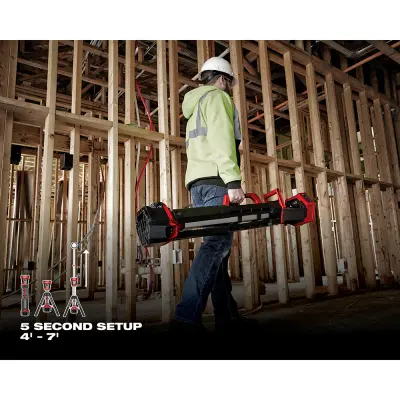
M18 ROCKET™ Tower Light
5-second setup. The jobsite light every tech needs.
Shop at Home Depot →Keep Reading

Got a question? A funny story? A win from the field?
Drop your email and share what's on your mind. Best questions become articles.