
You walk in. AC is running — blower's moving, condenser's humming — but the supply air is lukewarm. Or cool but not cold. The most common mistake on this call is connecting gauges before you've checked anything else. Airflow problems look like charge problems on a gauge set, and with A2L refrigerants now in the field, every unnecessary connection is another chance to vent refrigerant. Non-invasive checks first.
The three causes that cover most of these calls
Indoor airflow restriction — dirty filter, dirty coil, dirty blower wheel, duct issue — roughly 30-40%. Outdoor airflow or condenser problem — dirty coil, weak condenser fan — another 15-25%. Low refrigerant charge from an actual leak — 15-25%. Electrical (weak capacitor, pitted contactor, struggling compressor) and metering-device issues fill the rest.
Diagnostic flow
1. Measure return and supply temperature split.
Fast-response probes, return stream near the equipment, supply stream just downstream of the coil. Expect 16-22°F under common conditions, broader 14-23°F depending on humidity and airflow. High indoor humidity drops the sensible split because capacity is going into latent removal — a muggy house can show 13°F with a healthy system. Low split points to capacity loss (charge, compression, too much airflow, high latent load). High split points to low airflow.
2. Visual airflow triage before anything else.
Filter, evap face, blower wheel, collapsed flex, closed dampers, outdoor coil, condenser fan. Eyes and a flashlight. If the evap is iced, stop — thaw it before any refrigerant diagnosis because frozen coils invalidate every reading.
3. Pull static before you pull gauges.
Manometer and static tips. Many residential systems are rated around 0.5" WC max TESP. Field targets: roughly 0.4-0.6" normal, 0.8"+ means trouble. Return static at 0.4"+ alone is a strong clue for return restriction, dirty filter, or undersized return. High TESP keeps you on airflow. Normal TESP with weak cooling moves you forward.
4. Verify blower airflow and speed setup.
Residential cooling target is usually 350-400 CFM/ton. Check blower tables against measured TESP, confirm ECM programming or tap selection. ACCA QI says airflow should be within 15% of design. Low airflow explains a lot of "low on charge" misreads — low suction, low superheat in some setups, freeze risk, high split.
5. Inspect indoor and outdoor coils.
Dirty condenser drives head pressure up, hurts capacity, and creates high-subcool patterns that look like overcharge. Dirty evap distorts superheat and subcool. Clean first, then recheck. This is where real techs catch what gauge-happy techs miss.
6. Now decide if gauges are warranted.
If airflow, static, coil cleanliness, and blower setup are verified and the split is still abnormal — connect. If not, finish airflow and electrical first. A2L systems especially reward this discipline: every connection is handling risk.
7. Check charge by metering-device type.
Fixed orifice: target total superheat from manufacturer's chart using indoor WB + outdoor DB. Not a fixed number. TXV: target subcooling from the nameplate or manual. Rough TXV range is 8-14°F, often around 10°F ±3°F when no chart is available. TXV evaporator superheat typically 5-15°F. Read the charging chart on the condenser — that's the source of truth.
Pattern reading:
- Undercharge — low suction, low head, high SH, low SC
- Overcharge — high head, high SC, often low SH
- Low airflow — high split, low or unstable suction, freeze risk
- TXV restriction or underfeeding — high SH, high SC (starved evap)
- Non-condensables — high head with no airflow explanation
- Poor compression — high suction, low head, low capacity
8. Electrical and component checks.
Capacitors: compare to nameplate, commonly considered failed outside ±6% of rated µF. A 40 µF cap passes roughly 37.6-42.4 µF. Contactor: check for pitting, voltage drop across the contacts under load. Compressor windings: C-R lowest resistance, C-S higher, R-S should equal the sum. If a compressor draws locked rotor current and all external causes are eliminated — charge, restrictions, airflow, support components — then compressor failure is justified. Not before.
What to say to the customer
Dirty filter / airflow issue: "Your AC is running, but it can't move enough air across the indoor coil. That cuts cooling way down and can freeze the coil. Good news is it's an airflow problem, not a refrigerant leak or a major part."
Low charge from a leak: "This system doesn't use up refrigerant — if it's low, that means it leaked out. We can add refrigerant to restore cooling, but the right repair is finding and fixing the leak. Just topping off without dealing with the leak turns into another no-cooling call later."
Frozen coil: "The indoor coil is iced over right now, and that's throwing off every reading I'd take. We need to restore airflow and let the coil thaw first, then I can actually diagnose what's going on."
Compressor failure: "The compressor is the pump that moves refrigerant. The readings show it's running but not building the pressure difference it should, which is why the air isn't getting cold. Before calling it, I verified airflow, charge pattern, and the electrical support parts — so this isn't a guess."
End-of-life conversation: "This unit can still be repaired in some cases, but we're balancing repair cost against age, reliability, and refrigerant type. If the compressor or coil is the issue on an older system, comparing repair cost to replacement is worth doing rather than fixing one symptom on a system that's got more failures coming."
Common misdiagnosis
Adding refrigerant before checking airflow — airflow problems look exactly like low charge on a gauge set. Topping off without finding the leak. Replacing a capacitor when the compressor is actually failing (hard starting vs. bad compressor are different problems). Missing a dirty condenser and chasing a head pressure ghost. Not pulling static — ever. Condemning a compressor too early, before ruling out airflow, restrictions, and electrical support.
A note on A2L refrigerants
If you're working on an R-454B or R-32 system, your discipline matters more than your gauges. UL 60335-2-40 requires refrigerant detection systems that react at 25% of LFL. Lennox R-454B coils ship with factory leak-detection hardware that can't be mixed with non-OEM sensors. Your recovery machine, vacuum pump, leak detector, and manifold all need to be A2L-rated — older A1 tools aren't acceptable just because they seem to work. Left-hand threaded hoses and a fire extinguisher on the truck. As of early 2026, most service work is still R-410A because of the installed base, but new installs are shifting fast.
Key takeaways
- Temperature split is free information. Take it first, every time.
- Pull static before you pull gauges. Airflow problems masquerade as charge problems.
400 CFM/tonis the assumption behind most delta-T charts. Low-airflow setups change the expected split.- TXV gets subcooling. Fixed orifice gets target superheat from a chart. Don't mix them up.
- On A2L systems, every unnecessary connection is handling risk. Non-invasive checks aren't just good practice anymore — they're safer practice.
Was this helpful?
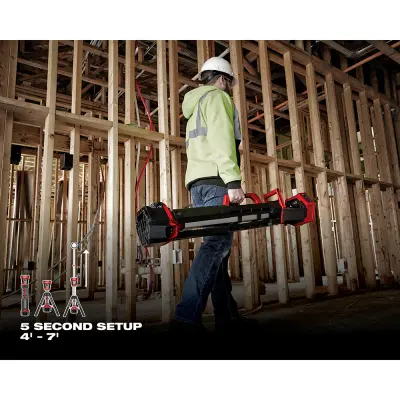
M18 ROCKET™ Tower Light
5-second setup. The jobsite light every tech needs.
Shop at Home Depot →Keep Reading

Got a question? A funny story? A win from the field?
Drop your email and share what's on your mind. Best questions become articles.