
Why Evacuation Matters
Air and moisture in a refrigerant system are enemies. Air causes non-condensable gases that raise head pressure, plus oxygen that reacts with refrigerant oil to form acids, plus premature compressor wear. Moisture causes ice formation at the metering device, hydrolysis of refrigerant and oil, and copper plating inside the compressor from acid breakdown.
Both are preventable by proper evacuation.
Evacuation Procedure
Equipment: A two-stage vacuum pump capable of achieving 500 microns or better. A vacuum gauge (micron gauge) — not a Bourdon tube gauge, which is not accurate in the deep vacuum range.
Target: 500 microns or below, confirmed by decay test.
Procedure: 1. Connect the vacuum pump using large-diameter hoses (5/16" or larger ID) to minimize restriction. 2. Evacuate to 500 microns. 3. Isolate the pump (close the valve at the hose connection, don't just shut off the pump). 4. Watch the micron gauge for 5-10 minutes. - Stays below 500 microns: clean and dry — proceed. - Rises slowly and stabilizes: moisture. Break with dry nitrogen and re-evacuate. Repeat until the decay test holds. - Rises quickly to atmospheric: there's a leak. Find it before you charge.
The decay test is not optional. Many technicians charge after seeing 500 microns without performing the decay test — this is how moisture gets into systems.
Common Mistakes
Leaving Schrader cores in during evacuation: The cores restrict flow dramatically. Remove them with a core removal tool and replace after evacuation. The difference in evacuation speed is substantial.
Long or small-diameter hoses: Every foot of hose and every fitting restricts pump-down speed. Use the shortest, largest-bore hose practical.
Old pump oil: A pump with old or contaminated oil won't pull deep. Change the oil regularly and warm up the pump before pulling deep vacuums.
Nitrogen Purging for Brazing
Brazing copper lines without nitrogen creates copper oxide scale inside the pipe. That scale flakes off over time and circulates through the system — plugging metering devices, scoring compressor valves, and contaminating the refrigerant.
Procedure: 1. Connect a nitrogen cylinder to one end of the line set through a regulator. Set to 1-2 PSIG — you just need flow, not high pressure. 2. Allow nitrogen to flow through the line while brazing. The nitrogen flowing past the joint displaces oxygen and prevents oxidation. 3. Maintain flow until the joint cools below 200°F.
Verify you're getting flow before you start brazing. A common mistake is connecting nitrogen and having the flow path blocked — you're brazing with zero nitrogen inside. Open both ends of the line set so you can verify flow before you close up.
Safety: Never use nitrogen from an unregulated cylinder. Regulator and relief valve are required. Never use oxygen or any gas other than dry nitrogen for purging or pressure testing.
Was this helpful?
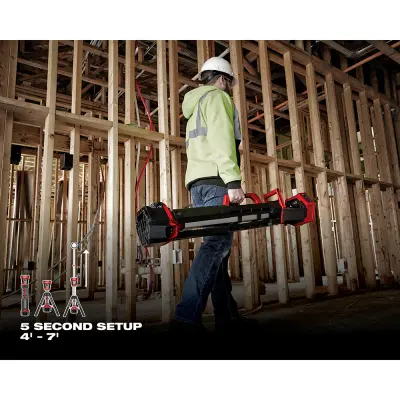
M18 ROCKET™ Tower Light
5-second setup. The jobsite light every tech needs.
Shop at Home Depot →Keep Reading

Got a question? A funny story? A win from the field?
Drop your email and share what's on your mind. Best questions become articles.